

Off The Croft Stories #010
The Cultural Crofter's Digest - November 2025

Hello friend / Halò a charaid,
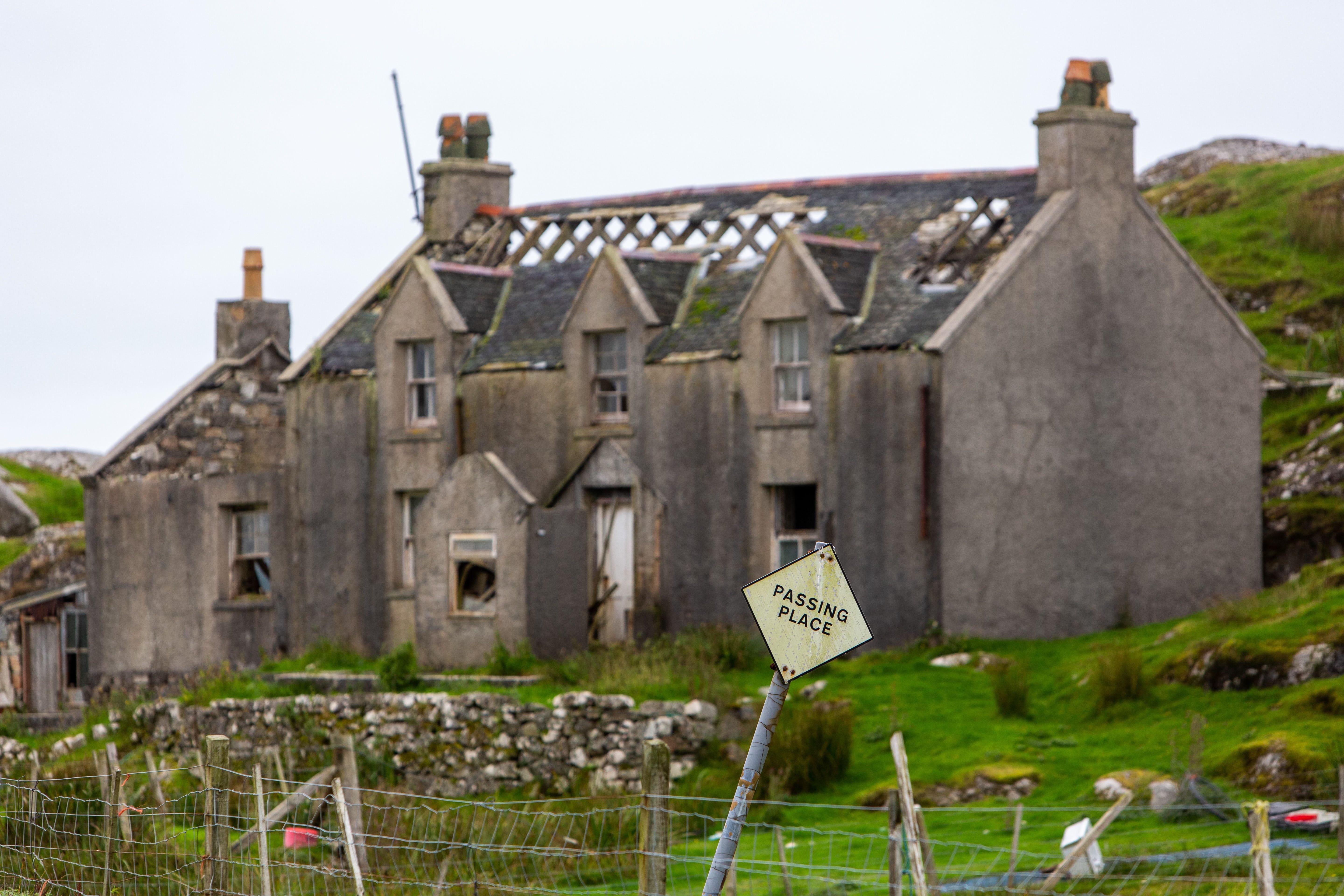
Beside an old home once full of its own stories, a lopsided sign is leaning into island life, bent but not broken. It’s the only way to survive the winter.
There’s goodness to give that has nothing to do with rules. It’s in slowing for sheep, waving to strangers, giving space to folks when the road is narrow.
This month’s digest follows that same spirit. Creative gestures, acts of artistic kindness, leaving a little room to let new ideas pass through.
As Ralph Waldo once said, “it’s not the destination but the journey”. So pull over into our cultural passing place and give way to what’s coming.
Relax, there’s no rush.
Mike

ONE / AON - ALICIA MATTHEWS
Alicia Matthews’ practice has moved through moving image, sound, performance and sculpture. Before making ceramics on the Isle of Lewis, she was part of Glasgow’s experimental underground with Optimo Music releases, Domestic Exile productions, DFA and MIC Records.
Her new body of work, An Cnàimh-Deoghail / The Suckling Bone, is a study of how bodies are made useful. Clay dug straight from the moor carries impressions of foetal shapes, pelvic joints, cogs, sockets and umbilical cords.
Rusting tractor engines are recast as vessels. Peat ash, breast milk, Lewisian gneiss and Siabost quartz are turned into glaze. These materials don’t imitate the land or the body, they are the land and the body.
The work sits somewhere between anatomy and industry. What happens when usefulness is exhausted? Do we discard the vessel, or does it find a new form of purpose in the peat, in the soil, as sediment and memory? Answers on a postcard…
The Suckling Bone will be exhibited at Grinneabhat, Isle of Lewis, from 22/11 - 09 /01

TWO / DHA - CAROLYNE MAZUR
Carolyne Mazur’s practice centres on the familiar structures we build our lives around, and the grief that follows when they disappear. Born to Scottish–Polish parents and now living on Mull, she records the landscape like an archivist, using photography to collect what is slipping out of sight.
Her project, Fangan, documents the stone sheep fanks of Mull, Iona and the surrounding islands. A fank is a simple pen for gathering and handling sheep, yet its walls hold more than crofting history: many are built from the houses of the people who once lived beside them.
Those homes were emptied during the Clearances, their stones torn down from dwellings was rebuilt as livestock enclosures. Mazur’s use of her drone reveals traces of that exchange, the faint outlines of vanished settlements pressed beneath grass, with fanks sitting where families once stood.
The work sits somewhere between archive and echo, exploring what remains when usefulness shifts from human to animal. Structures become picturesque ruins, architecture made from absence, holding a history that can’t be left behind.

THREE / TRI - MAIRI GILLIES
Mairi Gillies is a visual artist whose practice is rooted in language, landscape and material encounter. A Lowland-born Gael now living on Lewis, she works through Scottish Gaelic as a way of seeing, not as decoration, but as the lens through which place, memory and culture come into focus.
Her work is research-led, shaped by dialogue with tradition bearers and by gathering materials directly from the environment. She casts Lewisian gneiss, paints with spring water, and experiments with peat ash, kelp-smelted lead and earth pigments. These processes don’t just depict place; they enact it through touch, chemistry and transformation.
Gillies moves between studio, landscape and education, applying her methods across exhibitions, interpretation and creative learning. She’s even developed specialist casting and desiccation techniques for institutions including the Royal Botanic Garden Edinburgh and mainstream brands like Bombay Sapphire.
Working through both English and Gaelic, she also creates opportunities for people to make, think and learn through place. Whether designing gallery packs or running courses, Gillies treats education as a form of art-making, wrapping up her collaborative practice that roots creativity in shared knowledge and lived experience.

FOUR / CEITHIR - IAIN ANGUS MACLEOD
Iain Angus Macleod is a musician from the village of Manish, Isle of Harris and one of those multi-talented islanders who seems to carry five careers at once. When he’s not crofting, fishing, sailing or being a dad, he’s making and playing tunes and quietly building his creative musical practice online.
His instruments are the box accordion and acoustic guitar, played with a deep repertoire of old tunes that seem to live in his fingertips. For years he was a familiar face at local ceilidhs, playing with his band at community events, weddings and gatherings where the music mattered more than the spotlight.
Recently, Iain has been turning that heritage into new work of his own, most notably through At The Helm, which captures the salt-spray rhythms of life at sea. He’s also found a growing audience on TikTok, where he shares layered recordings of himself playing his instruments, alongside collaborative pieces with local singers.
His tunes sits between tradition and experimentation not reinventing the music, but revealing the craft behind it. Whether recording online or playing in a village hall, Macleod shows how island tunes evolve not by leaving their roots, but by being played, shared and shaped in the present.

FIVE / COIG - PAUL GLAZIER
When photographer Paul Glazier first landed on the Outer Hebridean island of Vatersay in 1978, he was a London schoolboy stepping into a wind-carved world of rock, sand and sea. It felt less like a trip and more like a homecoming and he returned every chance he had carrying a camera and an instinct that this place mattered.
Across decades, Glazier has photographed Vatersay’s people and its changing faces. Children from his earliest frames now have children of their own; parents have become great-grandparents. His archive grew not through deadlines or commissions, but by simply returning, year after year, to the same small island at the edge of things.
Trained in Fine Art at Goldsmiths and now based in Amsterdam, Glazier works across photography, moving image, painting and sound, often collaborating with performers and musicians. Yet Vatersay remains the centre of gravity, the landscape that shaped his eye and the community that keeps pulling him back.
His book Island Tides emerges as less documentary than devotion: a portrait of a place that doesn’t perform for the camera, but lives, ages and endures alongside it. Glazier isn’t just photographing Vatersay; he’s growing with it.

SIX / SIA - THE CADENCE OF A SONG
The biography The Cadence of a Song by Gaelic singer Fiona J. MacKenzie tells the story of Margaret Fay Shaw, an American ethnomusicologist who arrived in the Hebrides with curiosity and stayed long enough to capture its culture. She learned Gaelic, lived among crofters and spent years recording songs that could easily have vanished without her persistence.
The book shows the real labour behind her archive. Shaw built trust, not souvenirs, transcribing late into the night and photographing daily life without turning it into myth. Her work feels collaborative rather than extractive, shaped by friendships that gave her access to the voices she preserved.
What sets this biography apart is its sense of listening. The music leads, the photographs speak and the island communities become the centre of the story. Shaw emerges not as a collector but as a custodian who understood the responsibility of holding other people’s history.
The Cadence of a Song is a reminder that tradition survives through patience, relationships and close attention. It shows how one person kept music alive by choosing to stay and listen.

SEVEN / SEACHD - LIMBO
Limbo is a film which follows a small group of asylum seekers marooned on a fictional island while they wait on Home Office decisions. Shot on North and South Uist it uses the Outer Hebrides as more than scenery. The flat horizons, winter skies and half-empty roads become part of the story, turning the islands into a place where life feels paused, suspended between hope and nothing happening.
The film’s humour is dry and painfully accurate. Omar, a Syrian musician, drifts between awkward cultural awareness classes, bus stops blasted by weather and phone calls home where the silence hurts more than the words. The tone is deadpan but compassionate, finding humanity without sentimentalising anyone.
The islands rival him as the film’s strongest character. Community halls, croft tracks, sodium streetlights and long stretches of single-track road are captured exactly as they are. For those who know both Uists, this feels rare: the camera is finally paying attention.
But, in a film so rooted in place, several Scottish characters show up with a myriad of mainland accents that belong in Govan or Leith instead of Lochmaddy. But that’s just a small personal frustration in an otherwise sharp and beautifully observed story which reinforces the shared humanity and failings found in all of us, no matter where we call home.

EIGHT / OCHD - CLARKS WALLABEE
The Wallabee has always been a quiet icon in culture. In Jamaica it became a symbol of style among ‘rude boys’ in the 1970s. In New York and across hip-hop scenes it landed a second life: members of the Wu‑Tang Clan cementing the shoe’s legacy beyond footwear.
A boxy moc-toe, a crepe sole and a shape that never shouts for attention. Now it has been given a new skin that feels inevitable rather than experimental: Harris Tweed, woven in the Outer Hebrides, wrapped around a shoe already steeped in British history.
This version pairs the classic Wallabee silhouette with hand-woven tweed and scotch grain leather. It feels less like a collaboration and more like two old crafts recognising each other. One is stitched in Somerset, the other is spun, dyed and woven on looms in our island homes.
What makes this Wallabee stand out is how grounded it feels. Heritage is not decoration here. The tweed carries stories of crofts, weather and tradition while the crepe sole keeps the Wallabee’s familiar swagger. Together they create something stylish, understated and really rather wearable.

NINE / NAOI - HEBRIDEAN CHARCUTERIE
Hebridean Charcuterie from Croft No. 9 began in a garage on the Isle of Lewis. Brian and Melinda Whitington turned a French food obsession into a small-batch business built on crofting values: low emissions, low plastic, wild and free-range meats, and absolute honesty about where food comes from.
Their first product, Wild & Free Salami, launched in 2022, uses what the islands already provide. Crofters’ pigs, sheep and cows, along with wild deer and geese roaming the moors and shorelines, form the backbone of the range. This is charcuterie shaped by landscape, not big industry.
Even the packaging nods to heritage. The salami features a Nordic king inspired by the Lewis Chessmen, linking today’s crofting foods to the centuries of Norse influence that helped shape the islands. As the range grows, the full Chessmen set will appear piece by piece.
Small-scale, sustainable and deeply local, Croft No. 9 proves you can make exceptional charcuterie without leaving the Outer Hebrides. You just have to use what the island already offers.

TEN / DEICH - CAMPBELL SCANLAN
Campbell Scanlan is a designer and maker based in Uig, Isle of Lewis, specialising in bespoke interiors and handmade furniture. He offers a fully tailored service, taking projects from concept to fabrication to installation, all under one roof. Every piece is made to order in his workshop, with smaller products available through his online shop.
Raised in his island community, Campbell grew up surrounded by croft craft, resourcefulness and the culture of building things yourself. After working on timber self-builds across the Hebrides, he refined his skills at Duncan of Jordanstone, earning a degree in Product Design before returning home to build a practice rooted in place.
Since launching his business he has delivered a wide range of projects including hand-built kitchens, free-standing furniture, sculptural commissions and commercial interiors. His approach is versatile and practical, using a mix of materials and methods to suit scale and budget.
What defines Campbell’s work is not just craftsmanship, but the way it carries the logic of island making. It is thoughtful, functional and built to last, designs that feel grounded, because they come from a workshop on the edge of the Atlantic, not a factory somewhere far from our shores.
Thanks for reading if you made it this far!
If you enjoyed this issue, you can buy me a dram with a cheeky £3 donation to help support and inspire my writing 🥃
And, if you have something you think I should be turned on to, just drop me a link or a line via mike.thecroft@me.com
You can follow me on Instagram now too @mike.thecroft
Until next time, tioraidh an dràsta!
Didn't expect this take on usefulness. A systems thinking perspective!
Love reading your newsletter Mike. Thanks for the charcuterie introduction! Always looking for excellent quality UK examples, rather than buying European. We have some of the best animal welfare standards and it's important to me that, if we are to eat meat, the animal has had a good life and has been respected.